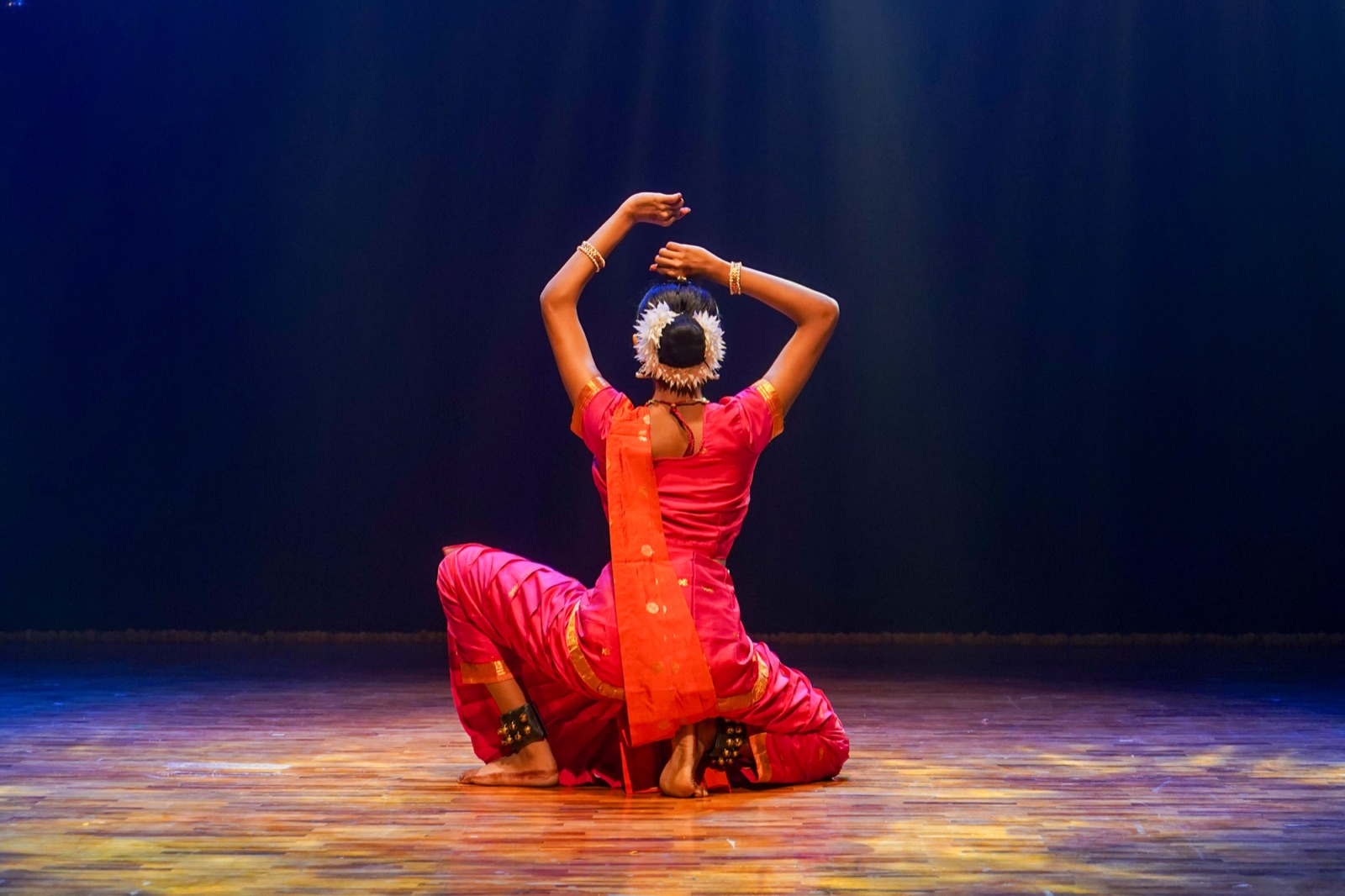
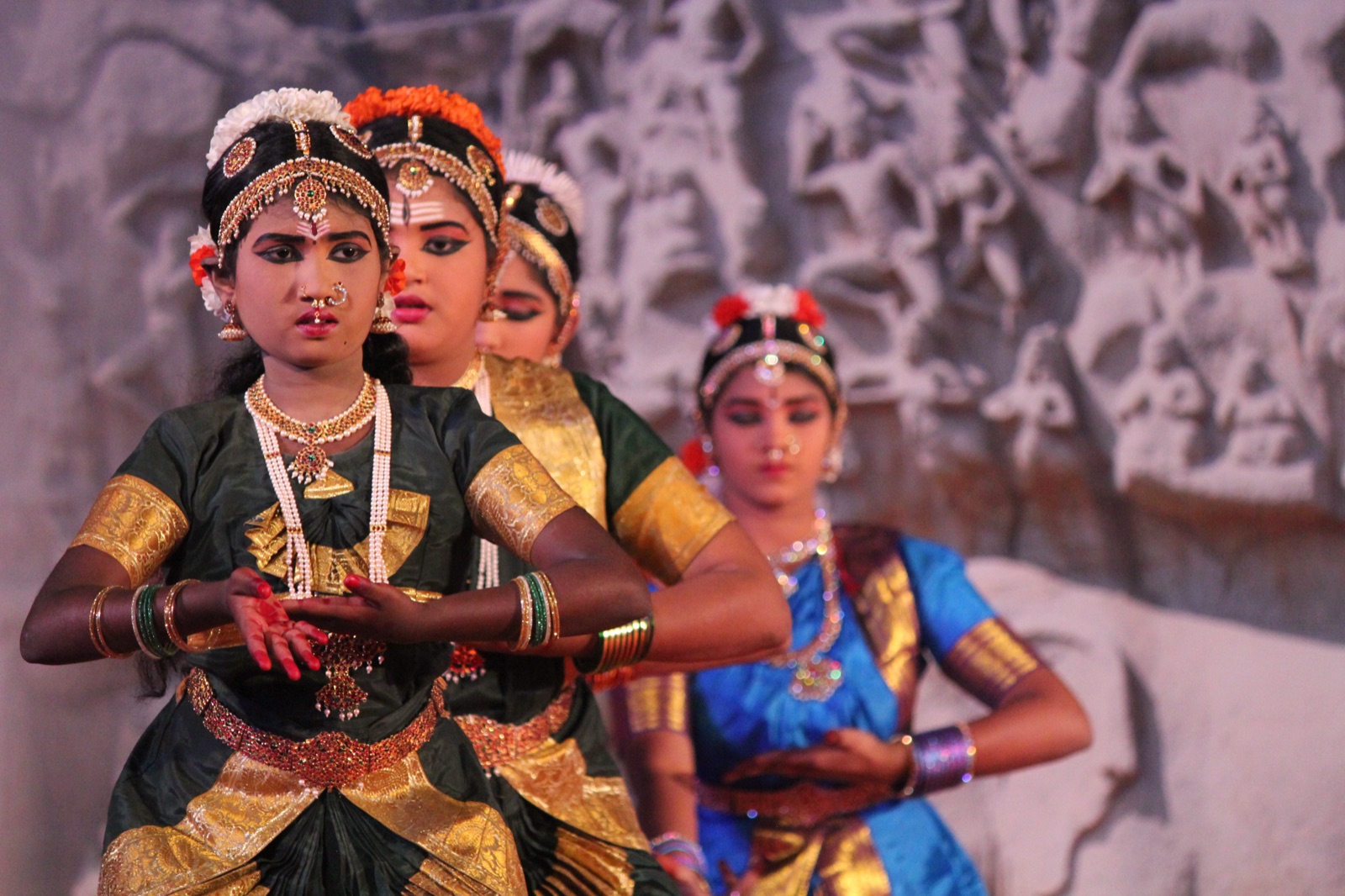
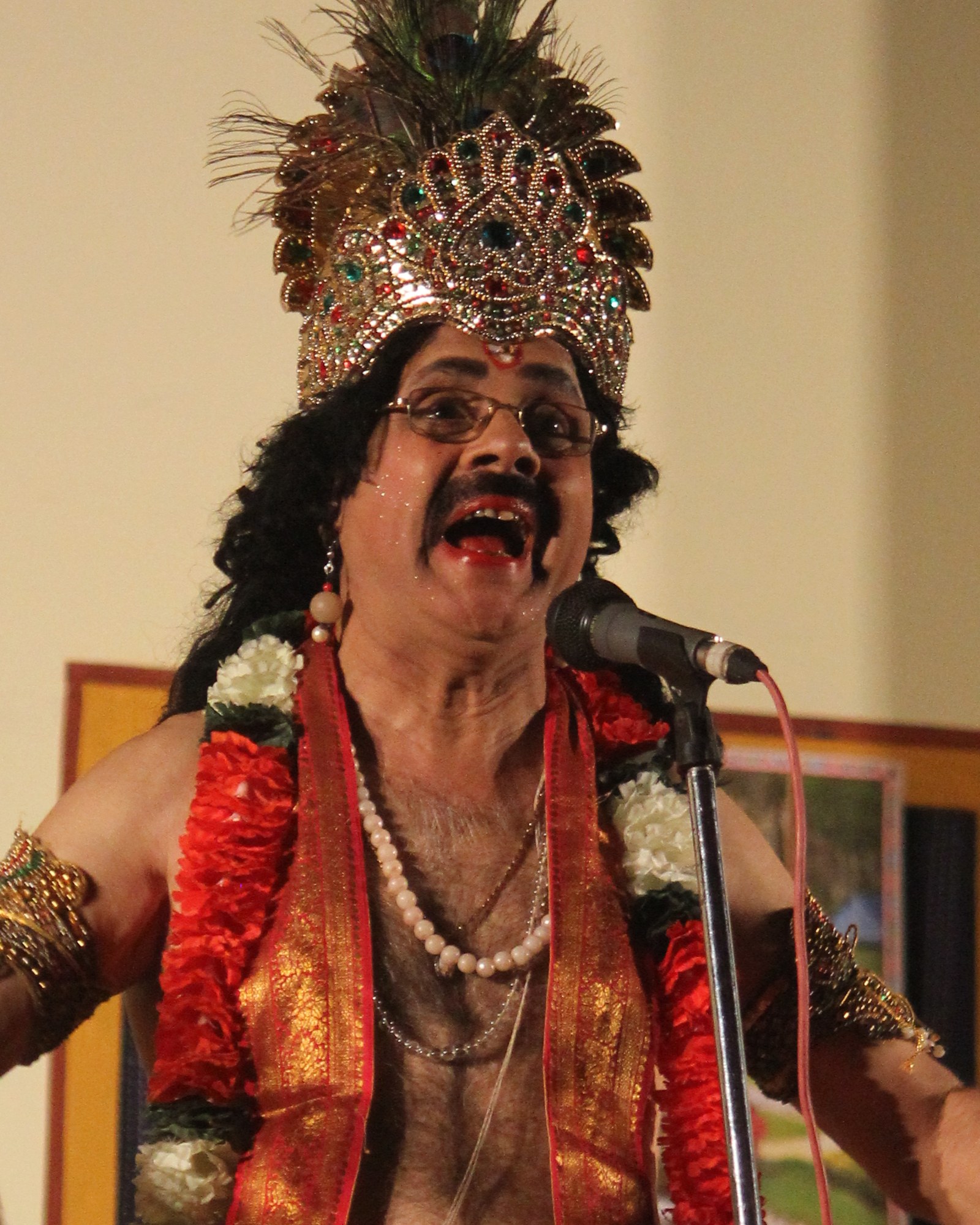
Bharatnatyam is a South Indian classical dance form. Bharatnatyam is a very ancient and traditional art form which has evolved over the last several centuries and is actively patronised by the current generation of artists both within and outside India. Bharatanatyam contains different types of baanis, baani, or tradition. Baani is a Tamil term used to describe the dance technique and style specific to a guru or school. These are named according to the village of the guru (with the exception of some baanis. Bharatanatyam style is noted for its fixed upper torso, bent legs and knees flexed (Arai mandi) combined with spectacular footwork, and a sophisticated vocabulary of sign language based on gestures of hands, eyes, and face muscles.The performance repertoire of Bharatanatyam, like other classical dances, includes nrita (pure dance),nritya (solo expressive dance) and natya (group dramatic dance). The word Bharatam is also seen as a backronym, with bha standing for bhavam (feelings, emotions),ra for ragam (melody, framework for musical notes), and tam for talam (rhythm).The term Natyam is a Sanskrit word for dance. The compound word Bharatanatyam is seen to connote a dance that harmoniously expresses bhavam,ragam and talam.
NaatyaBhoomi is your one-stop destination for anything and everything related to Bharatnatyam! NaatyaBhoomi helps you find Bharatnatyam teachers and schools, accessories, make-up, costumes, events or workshops, venues to dance at, and more! Join the NaatyaBhoomi community to get more involved with Bharatnatyam, interact with dance enthusiasts around the world, contribute to the community, and get a host of other benefits!
Bharatanatyam contains different types of banis. Bani, or 'tradition', is a term used to describe the dance technique and style specific to a guru or school.
These are named according to the village of the guru (with the exception of some banis).
Bharatanatyam style is noted for its fixed upper torso, bent legs and knees flexed (Aramandi) combined with spectacular footwork,
and a sophisticated vocabulary of sign language based on gestures of hands, eyes, and face muscles.
There are 3 main styles of Bharatanatyam:
~Vazhuvoor
~Pandanallur
~Melattur
Many styles branched out of these 3 main styles.
(Please Click on the boxes to see a video and information on the style)
1.Vazhuvoor Style:
2.Pandanallur Style:
3.Melattur Style:
Kalakshetra Style
Thanjavur Style
Mysore Style
Kalamandalam Style
The Raadha Kalpa Method
Naatyabhoomi blog aspires to be a platform for exchange of knowledge, ideas and new initiatives related to Indian classical dance and more specifically Bharatnatyam. We hope to bring curated blog posts from eminent practitioners, teachers, enthusiasts, sincere students and involved ecosystem players related to this artform. We sincerely request all the visitors and subscribers of the Naatyabhoomi community to participate by commenting and sharing your thoughts related to the posts and help foster an active discussion amongst the community members. If you have new ideas or thoughts that you would like to share as blogs with the fellow community members please write to us at: mridula.sriram@naatyabhoomi.com
As a dance student, I am constantly learning- each and every step, under the guidance of my guru.
One thing I am sure of is that the learning will never stop. Because in the world of dance, the magic never fades.
It may disappear into the shadows, but will always lightly ebb and trickle into the corners of this world.
For me, this world is always there.
A bubbling brook and swaying trees. The smell of pollen in the air.
Unique flowers waiting to be discovered.
Different paths waiting to be explored.
There is a problem.
It is such a huge world. There are too many flowers, too many paths.
There is only one brook.
I am confused.
A light shines through, so impossibly perfectly that I am nearly blinded.
It is the sun.
The sunlight gently warms my body and guides me. It teaches and pushes me, helping me explore new boundaries.
The sun is the Guru.
A guru, for any dancer, is the most important.
They tell them what is wrong and right, and which path to take.
From correcting your hands, lifting your arms and straightening your posture.
They will always be there for you, a reassuring presence in this big world.
Most of all, they give you knowledge, valuable information that you will carry and hold for the rest of your life.
A guru nourishes you.
What is sangeetam? Music, right? Sarangadeva in Sangeeta Ranakara, thinks of sangeetam as much more-
geetam vaadhyam tatha nrityam trayam sangeetamucchyate,
which means the trio of song, instrumental music and dance is called sangeetam.
To me it seems that this man-made sangeetam is only an encapsulation of the vivid sounds and dances in nature, be it the gurgling water in the brooks, the roll of the thunder, the rhythmic slapping of the waves in the ocean, the rustle of the leaves, the whoosh of the wind through the bowers, the song of the koel and the dance of the peacock.
I cannot imagine any dance form, be it classical or contemporary, Indian or Western, that is unaccompanied by music. In fact, the oldest treatise on Indian music is Natyashaastra by Bharata Muni, which devotes 6 chapters to music (out of 36). In the introductory portion of this text that dates to 200BCE to 200CE, it is said that Lord Brahma created Natyashaastra, the fifth veda, using elements of the text from the Rg Veda, the drama from Yajur Veda, the music and dance from the Saama Veda and the rasa from the Atharva Veda.
The cord that binds Indian music and dance has remained unbroken for two millennia as we know it, both evolving and metamorphosing with the times. The temple sculptures in eras and locations as diverse as Ellora, Mt Abu, Khajuraho, Konark, Chidambaram, Halebidu, Tanjavur or Darasuram, are rich testimony to this continuum. The graceful dancer is always depicted with the troop of the singers and players of musical instruments. Frozen they may be in stone, but to the discerning rasika, they are pulsating with rhythm, music and rasa.
Fast forward to the decade of 1930, when Sri.E.Krishna Iyer (a lawyer from Kallidaikurichi), along with Rukmini Devi Arundale resurrected Bharatanatyam and brought it back to mainstream. Krishna Iyer was an expert in Carnatic music and in dance. He was a music critic for Ananda Vikatan and Indian Express; he was a founding member of the Madras Music Academy and the Tamil Iyal Isai Nataka Mandram. He had danced, donning several roles in stage plays and movies, often acting as a lady, as women were prohibited from the stage in those days. The revolutionary in him was able to bring to stage the talents of several woman dancers, who went on to become legends, including the venerable Balasaraswathi. He was instrumental in picking up the compositions, the ragas and accompaniments that would enhance their dance performance, transporting the audience from a state of entertainment to enchantment and then to sublime enlightenment.
So, we have the contemporary music structure for the Bharatanatyam performance and for the dance- dramas. The singer conveys the poetry of the lyric, infusing it with the intended bhaava in every syllable, in every one of the numerous iterations of the lyric (sangatis), needed for the dancer to express the rasa in myriad abhinayas. The singer is accompanied by a violinist, a flautist and rarely a vainika, or a keyboard player to enhance the raaga experience. Unlike a music concert, where raaga aalapana and neraval are the crown jewels, the singer for a Bharatanatyam performance highlights the lyrics, sangatis, chittaswarams and swarajathis. A short aalapana may be used to provide a musical continuity, when the dancers are regrouping and also to provide the much-needed rest to the dancer in between two demanding high-energy phases of the dance.
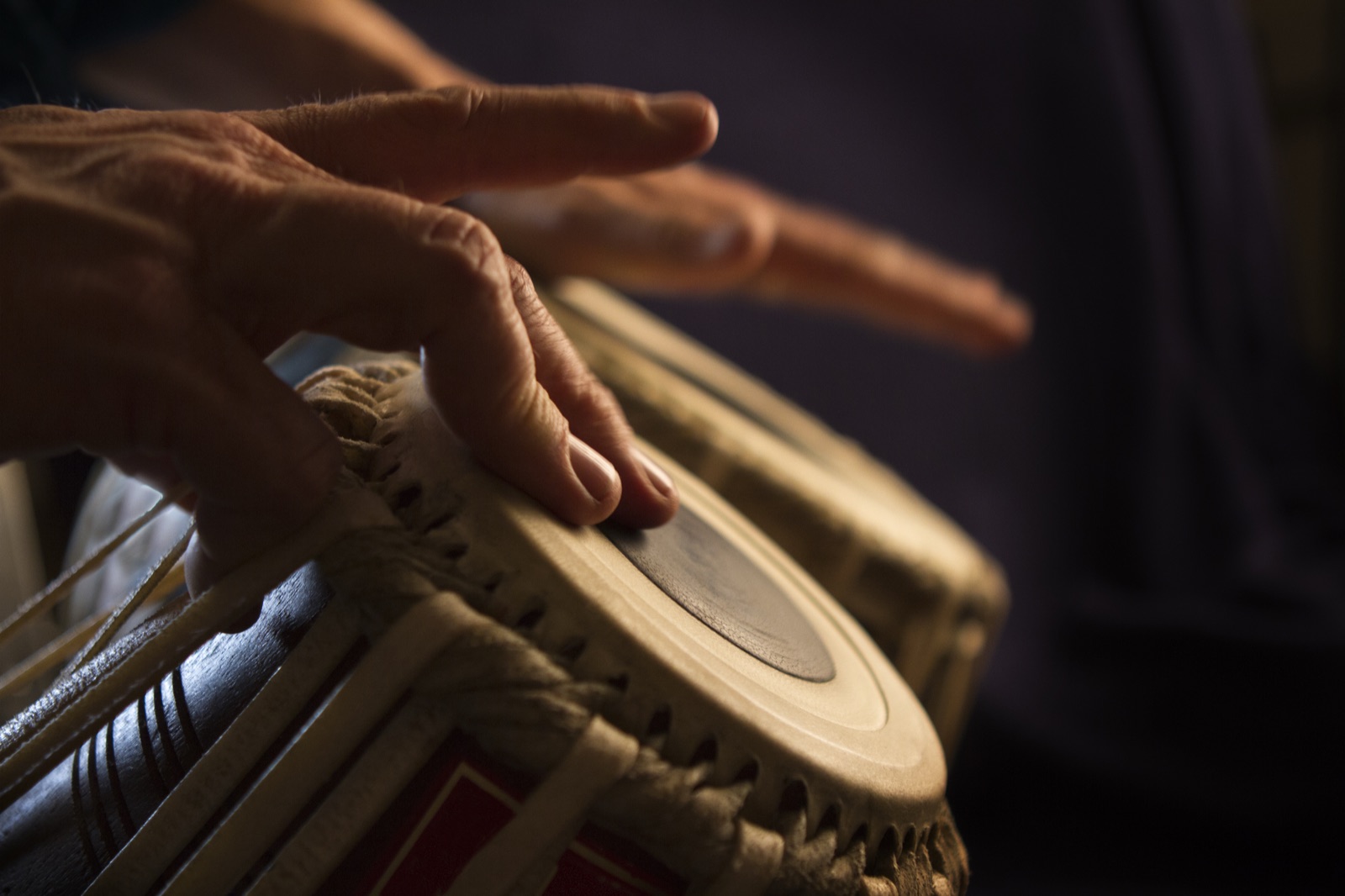
Shruti maataa, laya: pithaa it is said. The rhythm provided by the percussion ensemble is the very basis on which the dance is executed. The rhythm is provided by a mridangist, a tabla player, sometines a kanjira / ghatam / morsing/ konnakkol artiste and most importantly by the nattuvanar, who keeps the rhythm with a set of metal cymbals or simply a wooden stick hit on a wooden plank (thattuk kazhi).
Apart from the rehearsed portions that are faithfully reproduced, the laya team and the dancer sometimes engage in an ex-tempore sawaal jawaab challenge, serving up an intricate rapid rhythm for the dancer to execute it verbatim in the footwork. The jingle of the ankle bells (salangai) of the dancers, tell their own story and the fusion of these rhythms makes a very visceral connect with the audience and makes the audience tap their feet, follow the tala with their hands and nod their heads.
Nowadays, practical difficulties sometimes force the dancer to rely on recorded music. While this can be an indispensable rehearsal tool, it robs the audience of a holistic experience when it is used to do away with live singing and accompaniments on stage.
Part 2- A concluding part to follow, detailing the nature of the musical entities used in a dance performance.
First and foremost, I offer my humble pranams to my Guru Natya Kala Sarathy Smt Malathy Thothadri, Director Kalasagara, who by her selfless and endless teaching, guides me and helps me improve and innovate in this art form.
Bharathanatyam is a combination of the Nritta and Nrithya. Nritta involves performing the adavus or the dance steps rhythmically while Nrithya or abhinaya is the art of emoting and capturing the audience to elicit an empathetic response. For a successful performance the dancer must excel both in the Nritta and Nrithya.
While the angika abhinaya involves usage of body and limbs, the vachika abhinaya is expressing through songs and literature. The aharya abhinaya is expressed through adorning beautiful ornaments and costumes while the Saativika abhinaya is emoting feelings through soulful expressions from within. My guru has always taught us that all these four aspects of Abhinaya are very crucial for a dance performance. She has also emphasized that it is very important for the dancer to have sound music knowledge which will aid in expressing the correct abhinaya, be strong in rhythm and finally enjoy dancing. One should be able to understand the song or poem, its lyrical meaning, and the plot of the choreography to be able to bring out its complete essence through beautiful facial expressions and set the right mood.
For instance, when one is donning the role of Sita who has been abducted by the mighty King Ravana and has been kept in captive at the Ashoka Vana, the dancer must be able to imagine this grave situation and emote the right expressions at the right moment. Sita Devi was in immense grief when she was in the Ashoka Vana thinking about Rama all the time, but when Ravana comes to the Vana, she expresses pure disgust or the Bibastha rasa by comparing him to just a piece of grass and thereon fumes with anger or Roudra rasa when Ravana belittles Lord Rama. When Sita meets Hanuman, the messenger of Lord Rama, her joy knew no bounds and she showers her Karunyam and is also in awe of seeing the Rama Bhakthi of the mighty Hanuman and expresses Ascharya Rasa. So, the dancer here should be able to emote five different types of emotions gradually transitioning from one rasa to the other taking the audience along.
Solo performances involve dancers to completely emote the sanchari or the story end to end with the variations in expressions. Group dance dramas are very interesting involving a thematic presentation of an epic or a story. We have many dancers adorning beautiful character costumes, playing various roles taking the audience to a totally uplifted zone.
For young dancers, to be able to emote well, they can prepare a dialogue format as per their understanding so that it will be easier to bring out the right facial expressions. It is very essential to also keep in mind the eye, hand, limb positions, and the body movements as per the expressions the dancer intends to emote. One should understand the Nava Rasas or the 9 types of emotions and practice stories that are linked to these rasas to improve on their facial expressions. The crux of the situation or the story line that they are going to present should be clearly understood in the sequential order of events. The correct emotion must be expressed, and it should transition smoothly to create a massive impact. My Guru always encouraged us to watch a lot of dance programs by eminent Bharathanatyam artistes. She felt that it will help us improve a lot by learning certain good aspects and most importantly also understand that certain things do not look good and should be avoided while presenting on stage.
For me, abhinaya has been a favorite aspect right from my childhood. I have always been excited to perform padams or songs that involve varied expressions. I loved to be part of the group recitals of my institution. Among those, I have had the opportunity to play roles of Sri Kodhai Nachiyar, Sri Peria Azhwar, Sri Tulasi Das to name a few. But one role that has been very close to my heart was that of Sri Valli. The costume for Sri Valli was that of a huntress, a Kuravanji. She had immense bhakthi and affection on Lord Muruga. It was just not Bhakthi but Valli had to express sarcasm, anger and disgust at Lord Muruga who came disguised as a hunter and thereon as an old man showing interest in her. Finally, being scared by an elephant which was none other than Lord Ganesha, she begs the old man to save her. The emotional trauma she faces when she is forced to agree on marriage with the old man, is the pinnacle of the emotion that the dancer must take the audience to. I still remember my Guru emote this entire portion so beautifully to me. It will be etched in my heart as a beautiful memory forever.
I would also like to express my heartfelt gratitude to the founder of NaatyaBhoomi, Ms. Mridula Sriram for giving me this opportunity to pen down my thoughts on the abhinaya aspect of Bharathanatyam.
NaatyaBhoomi (a Sanskrit term meaning Land of Dance) is a platform that aims to aggregate a community of dance enthusiasts and common people and enable exchange of ideas, thoughts and knowledge of the art form. NaatyaBhoomi is a unique initiative to bring together the entire dance ecosystem (Exponents, Tutors, Students, Connoisseurs, Accessories Vendors, Venue providers etc) into a single platform thus aggregating a true dance community that benefits from exchange of ideas, information and resources. NaatyaBhoomi platform hopes to be the go-to place for anything and everything about dance. This is an initiative born out of a felt absence of such a community platform by an avid student through her learning years.